Skip to main content
Chapter 13
- We will be focusing on solutions
- A solution has 2 main components:
- Solute
- Solvent
- The solute is the small amount of substance going into water, and water is the solvent.
- A solute is the thing that is always in the smaller amount
- We need to be able to count the number of particles in solution
- "How much stuff is in this solution"
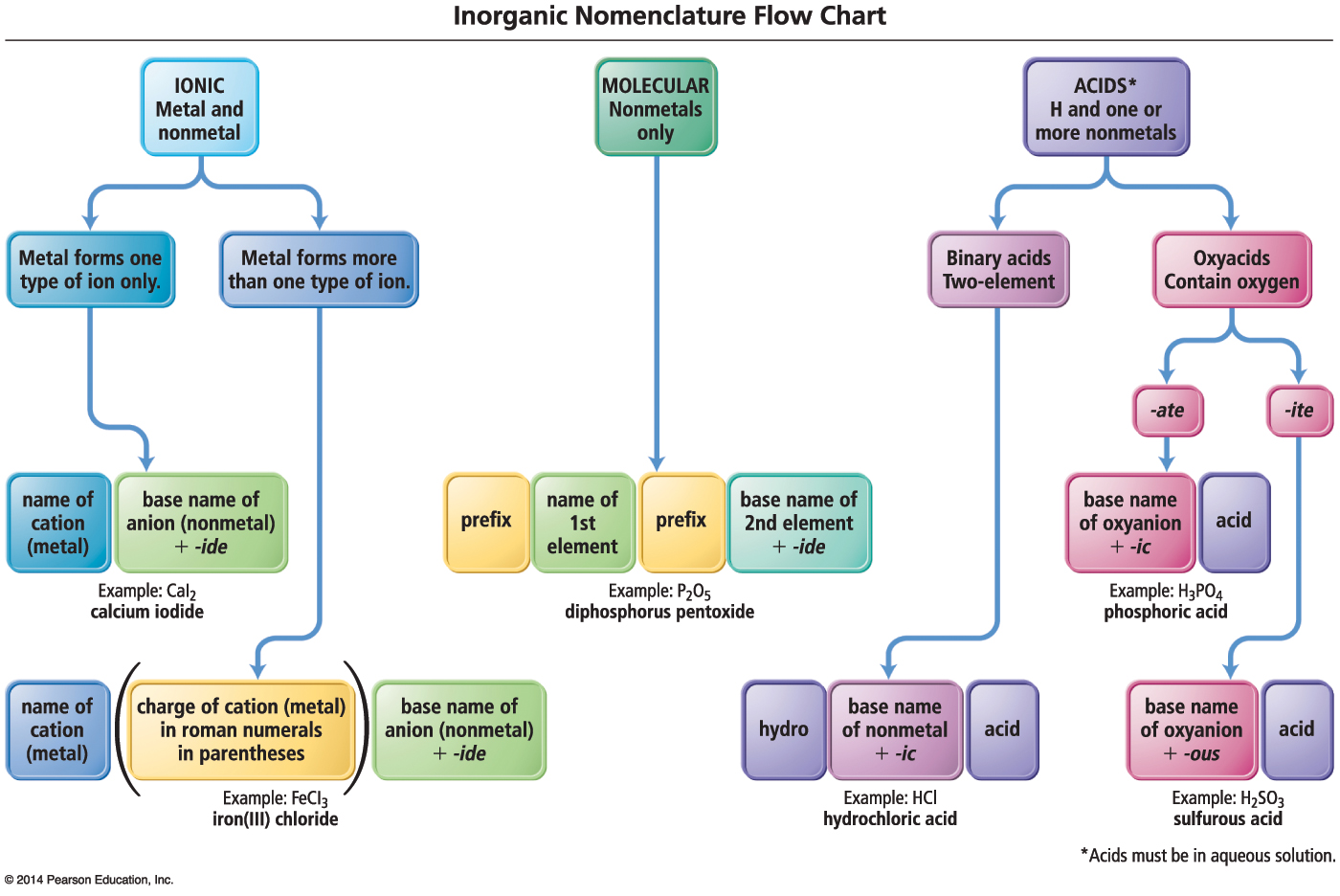
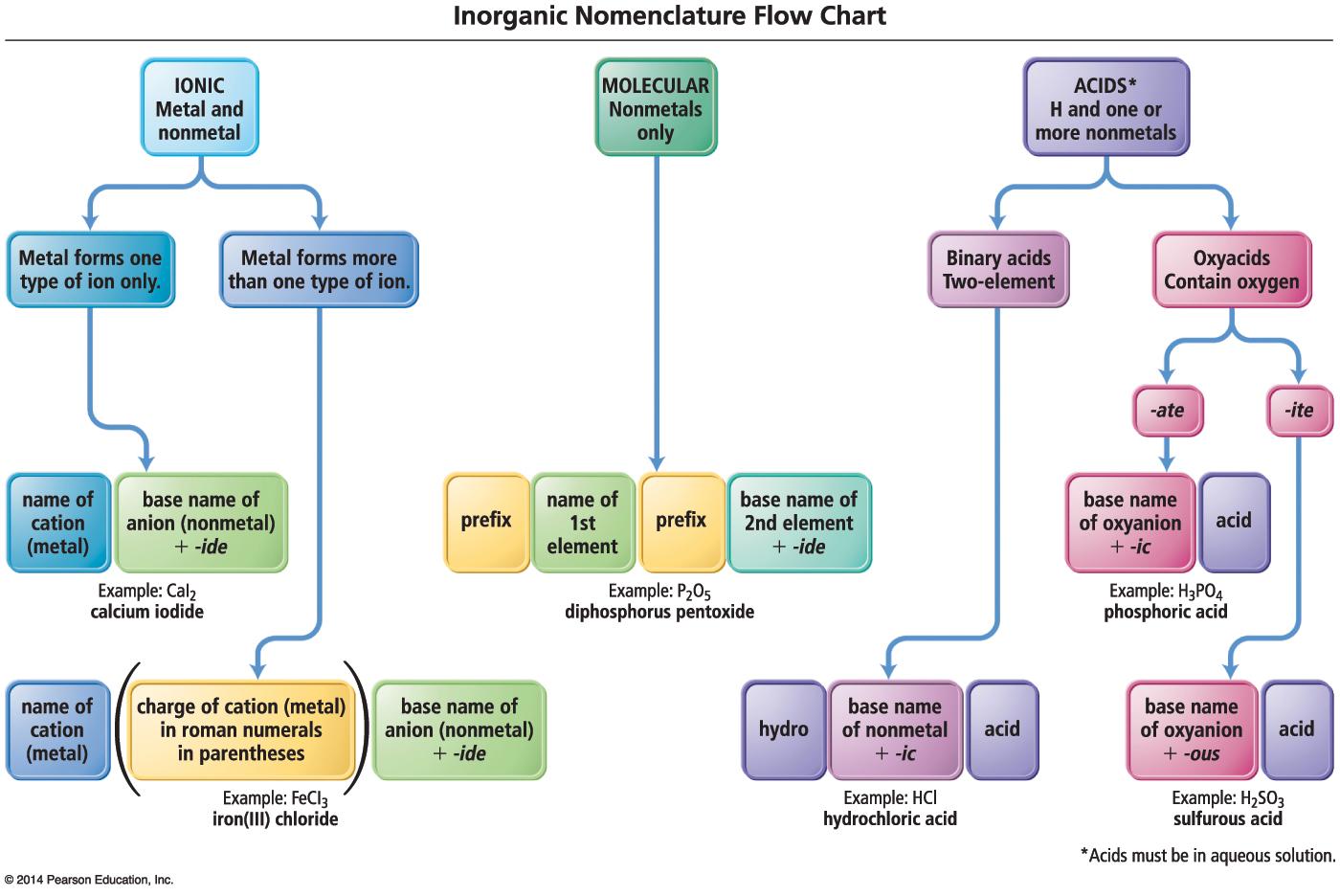
- Ionic vs Covalent
- Nomenclature
- Dissolution
- Disassociation
- Electrolytes
- Types of solutions and solubility
- A solution is a homogenous mixture containing small particles that will not separate. This leads to many transparent mixtures being made
- An aqueous solution is a solution where water is the solvent
- Solubility is the amount of substance that will dissolve
- Types of solutions that you can have are in table 13.1, p 564
- Why do solutions form?
- Entropy ($\Delta S$)
- The number of ways a system can be arranged
- Randomness/disorder (not as correct)
- Entropy always increases
- Entropy is favorable
- The effects of IMF's
- Dissolves: a solid going into a liquid
- A gas can also go into a liquid
- Miscible: the liquids are soluble
- Like dissolves like
- The IMF's of the solute are similar or favorable to the solvent
- Three main interactions when making solutions
- Solute-solute interactions - break these
- Solvent-solvent interactions - break these
- Solute-solvent interactions - form these
- Energy needs to be favorable to make a solution
- Oil and water do not mix due to this same thing
- Energetics of solution formation
- Energy changes in solution formation
- Separate solute particles ($+\Delta H_{solute}$)
- Separate solvent particles ($+\Delta H_{solvent}$)
- Form solute-solvent interactions ($-\Delta H_{mixing}$)
- Add energy to pure components
- The first step is at an energy cost to us
- The second step is an energy cost to us
- The third step releases energy, we just don't know how much
- Endothermic or exothermic
- $\Delta H_{solution} = \Delta H_{solute} + \Delta H_{solvent} + \Delta H_{mixing}$
- Heat of hydration
- The enthalpy change when one mole of the substance dissolves in water
- $\Delta H_{solution} = \Delta H_{solute} + \Delta H_{hydration}$
- $\Delta H_{solute}$ is actually equal to the $-\Delta H_{lattice}$
- Will a solution form?
- Up to Gibb's free energy
- $\Delta G = \Delta H - T\Delta S$
- If $\Delta G$ is negative, it is a spontaneous reaction
- If $\Delta G$ is positive, it is a non-spontaneous reaction
- Solution equilibrium and factors affecting solubility
- Saturated: the solubility limit has been reached
- Unsaturated: more solute will dissolve
- Supersaturated: more solute is dissolved than should be able
- Effect of temperature on the solubility of solids
- As temperature is increases, solubility increases IN MOST CASES
- Factors affecting the solubility of gases
- As temperature increases, solubility decreases
- As pressure increases, solubility increases
- Henry's Law: $S_{gas} = k_{H} \times P_{gas}$
- $M (\frac{mol}{L}) = \frac{M}{atm} \times atm$
- Expressing solution concentrations
- Molarity
- $\text{Molarity (M)} = \frac{\text{moles of solute}}{\text{moles of solution}}$
- Molality
- $\text{Molality (m)} = \frac{\text{moles of solute}}{\text{kg of solvent}}$
- At low concentrations, these are very similar
- $\text{Mole fraction (X)} = \frac{\text{moles of component}}{\text{total moles making up the solution}}$
- $\text{Mass percent} = \frac{\text{mass of component}}{\text{total mass of solution}} \times 100$
- $\text{Parts per million (ppm)} = \frac{\text{mass of component}}{\text{total mass of solution}} \times 10^6$
- $\text{Parts per billion (ppb)} = \frac{\text{mass of component}}{\text{total mass of solution}} \times 10^9$
- If you are not told how much you have, you have to assume
- Make it easy for yourself. Assume 1L, 1kg, or 100g, depending on what you are calculating
- Density will also be used
- Colligative properties
- These depend only on the amount of dissolved particles, not on their chemical identities
- How many particles does that solute make.
- 4 main properties
- Vapor pressure lowering
- Freezing point depression
- Boiling point elevation
- Osmotic pressure
- Vapor pressure lowering
- The solution that is made will have a lower vapor pressure than that of its pure solvent
- Add solute, lower vapor pressure of solution
- Raoult's law
- $P_{\text{solution}} = X_{\text{solvent}} \times P_{\text{solvent}}$